
.png)



Recycling to Resource Security: How Battery Recycling Can Reduce India’s Dependence on Critical Mineral Imports


 >
>
Recycling to Resource Security: How Battery Recycling Can Reduce India’s Dependence on Critical Mineral Imports
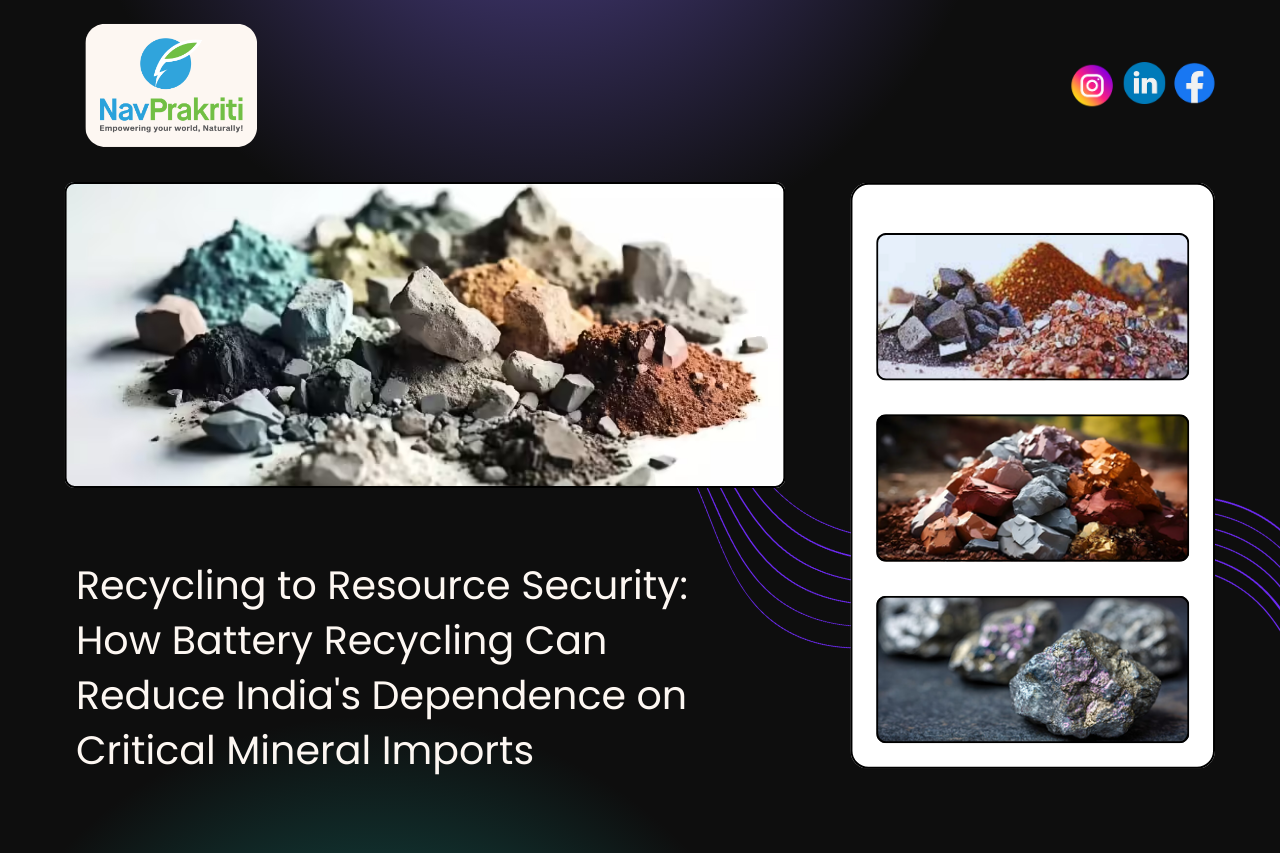
India’s electric vehicle ambitions are audacious. The government envisions 30% EV penetration by 2030. Battery energy storage systems are projected to reach gigawatt-scale deployment. The entire energy transition—from fossil-fueled transportation to renewable-powered grids—hinges on one critical enabler: lithium-ion batteries.
Yet here’s the uncomfortable reality: India produces virtually none of the critical minerals these batteries require. We import approximately 70% of our lithium-ion cells. The raw materials within them—lithium, cobalt, nickel, graphite—come almost entirely from foreign sources. China controls over 60% of global lithium refining capacity. The Democratic Republic of Congo supplies 70% of the world’s cobalt. Australia dominates lithium mining. Indonesia controls nickel.
This dependence creates profound vulnerabilities. Supply disruptions, geopolitical tensions, price volatility, or export restrictions by mineral-rich nations could derail India’s entire electrification roadmap. The question isn’t whether this matters—it’s what we’re going to do about it.
The answer is closer than most realize. It’s sitting in workshops, parking lots, and soon, in enormous quantities at end-of-life: spent lithium-ion batteries. India’s pathway to resource security doesn’t require discovering vast domestic mineral deposits. It requires building world-class infrastructure to recover, purify, and reuse the critical materials already within our borders—embedded in batteries we’ve already imported.
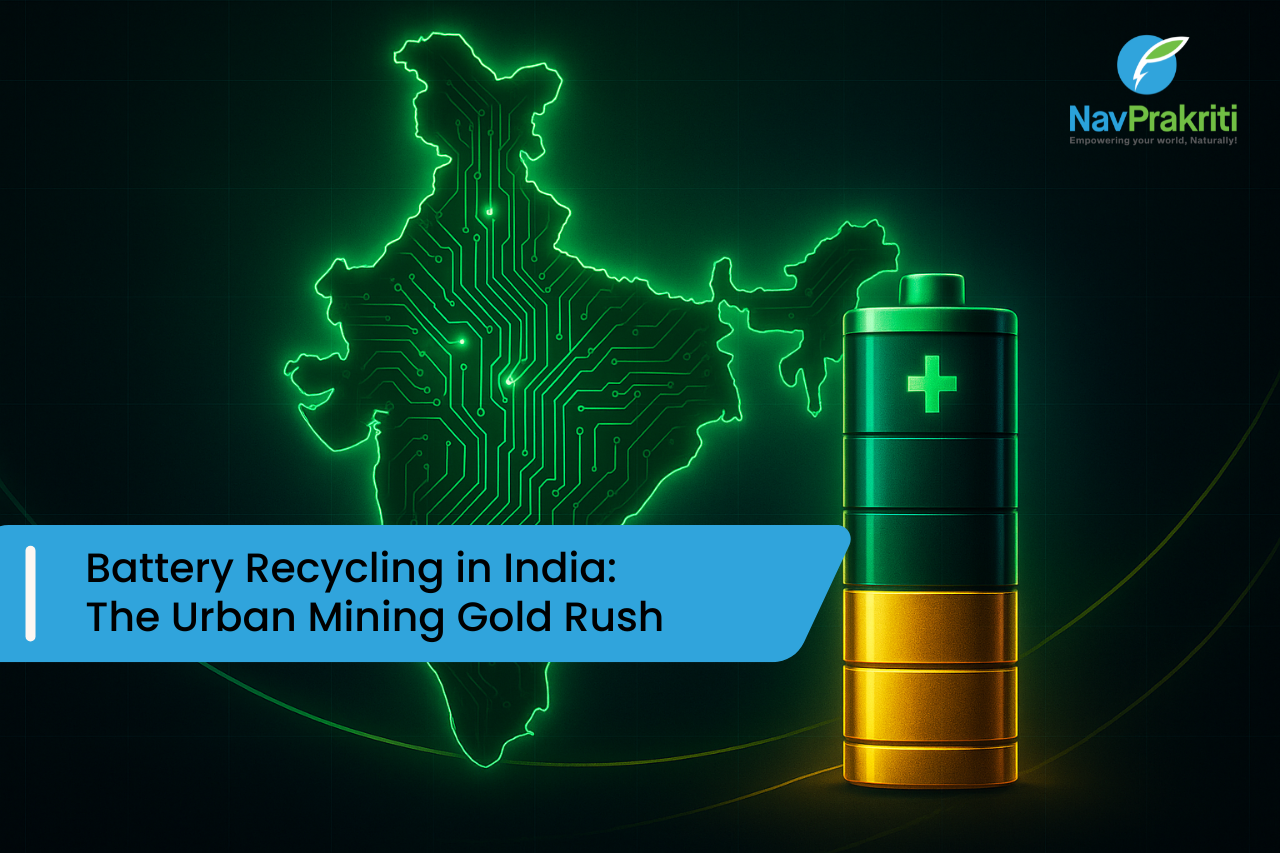
The Scale of Opportunity: India’s Growing Urban Mine
Every lithium-ion battery is essentially a concentrated mineral deposit. A typical EV battery pack contains approximately 8-10 kg of lithium, 10-15 kg of cobalt, 30-40 kg of nickel, and 20-25 kg of manganese—alongside copper, aluminum, and graphite. These aren’t trace elements; they’re substantial quantities of high-value materials.
As India’s EV fleet grows, so does this “urban mine.” Current estimates project that by 2030, India will have approximately 128 gigawatt-hours of end-of-life lithium-ion batteries available for recycling. To contextualize that figure: it represents the battery capacity of roughly 2.5 million electric vehicles, or the equivalent of several large-scale grid storage installations.
The material content is staggering. That 128 GWh of spent batteries contains an estimated 15,000-20,000 tonnes of lithium carbonate equivalent, 35,000-40,000 tonnes of cobalt, 80,000-100,000 tonnes of nickel, and similar quantities of manganese, copper, aluminum, and graphite. These aren’t abstract numbers—they’re the building blocks for millions of new batteries.
Current projections suggest that recycling could fulfill 30-40% of India’s lithium demand by 2030. For perspective, India currently imports nearly 100% of its lithium requirements. A shift to 30-40% domestic supply from recycling represents one of the most significant resource security improvements achievable in the next decade.
The mathematics are compelling. If India achieves 90% collection rates and 95% recovery efficiency—both technologically feasible with proper infrastructure—recycled materials could supply a substantial portion of new battery production. This isn’t theoretical; it’s a concrete pathway to reducing import dependence.
Beyond Lithium: The Full Spectrum of Critical Mineral Recovery
While lithium captures headlines, battery recycling addresses a broader resource security challenge across multiple critical minerals.
Cobalt presents perhaps the most acute vulnerability. Nearly all of India’s cobalt is imported, with the Democratic Republic of Congo supplying the majority of global production. Political instability, ethical concerns around mining conditions, and concentration of supply create persistent risks. Recycled cobalt can substitute for virgin material with zero performance compromise—every kilogram recovered is one less kilogram we depend on external sources for.
By 2030, if India recovers cobalt effectively from end-of-life batteries, recycling could supply 40-50% of domestic demand. Given cobalt’s cost—often the most expensive component per kilogram in a battery—this represents both resource security and significant economic savings.
Nickel is equally critical, especially as battery chemistries evolve toward higher nickel content for increased energy density. India’s domestic nickel production is minimal, with Indonesia and Philippines dominating global supply. Recent export restrictions by Indonesia sent shockwaves through battery supply chains, underscoring the geopolitical risk. Recycling offers a buffer—a domestic source insulated from international market disruptions.
Manganese and graphite, while more abundant globally, still require imports. Graphite, in particular, undergoes energy-intensive processing to achieve battery-grade purity—processing dominated by China. Recovering high-quality graphite from spent batteries reduces dependence on this concentrated supply chain.
Even materials like copper and aluminum, while not as supply-constrained, benefit from recycling. The energy required to produce primary aluminum is enormous; recycled aluminum requires 95% less energy. In a country working to reduce industrial carbon intensity, these savings compound.
The Economics: Cost Competitiveness and Price Stability
Resource security carries economic dimensions beyond simple import substitution. The volatility of global mineral prices creates planning uncertainty for battery manufacturers and vehicle OEMs. Lithium prices, for instance, spiked over 400% between 2021 and 2022 before crashing in 2023. Cobalt has experienced similar swings.
Recycled materials offer relative price stability. While not entirely decoupled from virgin material markets, recycled content benefits from localized supply chains with lower transportation costs and reduced exposure to international commodity speculation. Some techno-economic analyses suggest recycled battery materials can be produced at 30-40% lower cost than virgin equivalents when recycling operations achieve scale.
For Indian battery manufacturers, this cost advantage is strategic. Competing globally requires cost competitiveness; accessing cheaper recycled inputs helps offset other cost disadvantages. For consumers, it translates to more affordable EVs and energy storage—critical for mass-market adoption.
The capital and operating costs of recycling facilities are substantial, but compare favorably to mining and refining infrastructure. A large-scale battery recycling plant might require $50-100 million in capital investment. A lithium mine and refinery complex? Often exceeds $500 million. The entry barriers to building domestic recycling capacity are vastly lower than establishing mining and primary processing operations.
Environmental and Carbon Advantages: The Hidden Resource Benefit
Resource security discussions typically center on supply availability and cost. But there’s a third dimension: environmental impact.
Mining critical minerals carries significant ecological costs. Lithium extraction from brine deposits in South America consumes enormous quantities of water in arid regions, threatening local ecosystems and communities. Hard-rock lithium mining involves blasting, crushing, and chemical processing. Cobalt mining in the DRC has documented environmental degradation and social concerns. Nickel laterite processing generates substantial tailings.
Every kilogram of recycled material is a kilogram that doesn’t require new mining. The carbon footprint comparison is stark: producing lithium from recycling generates approximately 30-40% of the emissions of primary lithium extraction and refining. For cobalt and nickel, recycling offers similar carbon advantages.
As India commits to net-zero targets and as global supply chains increasingly demand lower-carbon materials, recycled content becomes a competitive advantage. European regulations are beginning to require minimum recycled content in new batteries. Similar mandates may emerge globally. Indian manufacturers using high recycled content will be better positioned for these markets.
This environmental dimension of resource security is often overlooked but increasingly material. True resource security isn’t just about having materials—it’s about having them in ways that are sustainable and aligned with climate commitments.
The Geopolitical Lens: Supply Chain Sovereignty
The past several years have demonstrated how quickly international supply chains can fragment. COVID-19 disruptions, Russia-Ukraine conflict impacts on commodity flows, China-US tensions affecting technology supply chains—all underscore the risks of depending on complex, geographically dispersed supply networks for critical needs.
Battery minerals are particularly exposed. Lithium processing is concentrated in China. Cobalt mining is concentrated in the DRC. Nickel refining is dominated by a handful of countries. Any disruption—whether from conflict, natural disaster, labor disputes, or policy changes—ripples through global battery supply chains.
India experienced this directly in 2023 when Indonesia restricted nickel ore exports, causing supply tightness and price spikes. Similar scenarios could emerge for lithium if major producers implement export controls, or for cobalt if DRC experiences political instability.
Domestic recycling creates buffer capacity—a strategic reserve of sorts, but one that continuously replenishes rather than depleting. In times of international supply disruption, a robust domestic recycling sector ensures continued material availability for critical industries. It’s resource security in its most literal sense.
This isn’t about autarky—complete self-sufficiency is neither realistic nor necessarily optimal. But it is about resilience: reducing single-points-of-failure, diversifying supply sources, and ensuring that external disruptions don’t halt domestic industrial activity.
For policymakers, battery recycling should be viewed not just through environmental or economic lenses, but through the strategic framework of industrial policy and national security. It’s infrastructure as critical as domestic steel production or semiconductor fabrication—foundational to economic sovereignty in an electrified future.
From Potential to Reality: Policy Levers and Industry Action
The potential is clear. Realizing it requires coordinated action across multiple fronts.
✅ Recycled Content Mandates: India should implement minimum recycled content requirements for new batteries sold domestically. Starting modestly—perhaps 10% by 2027, scaling to 30% by 2030—such mandates create guaranteed demand for recycled materials, improving recycling economics and incentivizing investment. European Union regulations already mandate this; India should follow.
✅ Preferential Procurement: Government procurement of EVs and energy storage systems should prioritize suppliers using high recycled content. This leverages government purchasing power to develop domestic recycling markets while fulfilling broader resource security objectives.
✅ Import Duty Structures: Differential duties could favor recycled materials or batteries with certified recycled content, making them more cost-competitive and accelerating their adoption.
✅ Closed-Loop Incentives: Battery manufacturers who establish take-back and recycling partnerships should receive preferential treatment in licensing, financing, or procurement. This aligns corporate incentives with national resource security goals.
✅ R&D Support: Government-funded research into advanced recycling technologies—higher recovery rates, lower energy consumption, novel separation methods—will keep India at the technology frontier and improve long-term competitiveness.
✅ Infrastructure Investment: Just as India invests in charging infrastructure to enable EV adoption, investment in collection and recycling infrastructure enables resource recovery. Both are necessary components of the EV ecosystem.
For industry players, integration of recycled materials must become standard practice, not an afterthought. Battery manufacturers should design for recyclability and establish supply agreements with recyclers. Vehicle OEMs should treat end-of-life battery management as integral to their operations. Recyclers like Nav Prakriti must continue scaling operations and improving efficiency to ensure material availability and quality.
A Vision for 2035: India’s Circular Battery Economy
Imagine India in 2035. Lithium-ion battery production capacity has scaled to 200+ GWh annually, supplying both domestic vehicle and storage demand and export markets. Of the critical materials flowing into new batteries, 50% comes from domestic recycling operations. Import dependence has been cut in half.
Price volatility has diminished—recyclers provide stable, predictable supply that buffers against international market swings. Indian battery manufacturers compete globally on cost and environmental performance, leveraging their access to low-carbon recycled content. The country has avoided tens of billions in mineral import costs while creating hundreds of thousands of skilled jobs in recycling operations.
End-of-life batteries no longer enter informal waste streams. A comprehensive collection network—incentivized, tracked, and enforced—ensures virtually all spent batteries reach certified recyclers. India has become a model for battery circularity, demonstrating to other developing nations that rapid EV adoption and resource security can be mutually reinforcing rather than conflicting goals.
This isn’t fantasy. The technology exists. The economic logic is sound. The policy tools are available. What’s required is recognition of battery recycling not as a waste management necessity but as strategic industrial infrastructure—as vital to India’s electric future as battery manufacturing itself.
The Imperative of Action
At Nav Prakriti, we see both the opportunity and the urgency. Every day, batteries that could supply tomorrow’s EVs risk entering informal processing or simply being stored indefinitely, their materials locked away. Every month of delay in building comprehensive recycling infrastructure is a month of continued import dependence and lost resource security.
But we also see momentum building. EPR regulations are strengthening. Industry awareness is growing. Investment is flowing into recycling capacity. The foundations are being laid.
The question is whether India will move fast enough and deliberately enough to capture this opportunity. Will we build the circular battery economy our resource security requires? Or will we remain perpetually dependent on imported materials, vulnerable to external disruptions and price shocks?
The batteries for India’s electric future are already here—some currently in use, others approaching end-of-life. They contain the lithium, cobalt, nickel, and other materials we need. The challenge isn’t accessing these materials; it’s building the systems to recover and reuse them.
Resource security through recycling isn’t a distant aspiration. It’s an achievable objective for this decade—if we recognize its strategic importance and commit to making it reality. India’s electric future depends not just on importing batteries and minerals today, but on recovering and reusing them tomorrow.
The urban mine is here. It’s time we started mining it.






Leave a Reply