.png)



 >
>
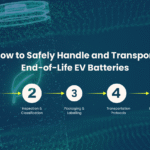
Safely Handle and Transport EV Batteries End-of-Life
Electric vehicles are transforming India’s mobility landscape. But with this transition comes a critical responsibility: what do we do with EV batteries once they retire? Even when no longer powering vehicles, these batteries remain hazardous if not managed properly. Knowing how to safely handle and transport EV batteries at end-of-life is not just best practice, it’s essential for safety, compliance, and sustainability.
Why We Must Safely Handle and Transport EV Batteries
End-of-life (EOL) lithium-ion batteries are different from ordinary waste. They demand strict handling procedures because:
- ✅ Residual charge can trigger sparks or thermal runaway.
- ✅ Electrolyte leaks may cause toxic exposure.
- ✅ Improper storage or transit could lead to fire incidents.
- ✅Legal compliance under India’s Battery Waste Management Rules (2022) requires that only authorised entities manage collection and transportation.
In short: ensuring safe transport is the first step toward creating a circular battery economy.
Step 1: Safe Discharge
Before moving any EOL battery, it must be discharged to near-zero voltage. This neutralises the risk of fire or shock. Controlled discharge units allow the energy to be safely removed — and in some cases, repurposed for secondary use.
Step 2: Inspection and Classification
No two EOL batteries are alike:
- ✅ Damaged packs (bulging, leaking, or ruptured) must be isolated immediately.
- ✅ Healthy but degraded packs may be repurposed for second-life uses, such as stationary storage.
Classification ensures that each battery follows the right pathway for transport and recycling.
Packaging Guidelines to Safely Handle and Transport EV Batteries
Packaging is a critical barrier between risk and safety:
- ✅ Use UN-certified containers designed for lithium-ion batteries.
- ✅ Place non-conductive fillers like vermiculite or foam to prevent contact.
- ✅ Clearly label each container as “Lithium-ion Battery — For Recycling.”
- ✅ For large packs, fire-resistant steel or wooden crates are preferred.
This step ensures batteries remain stable even during long-distance transit.
Step 4: Transportation Protocols
Moving EOL EV batteries requires more than just logistics trucks:
- ✅ Only trained personnel should handle loading and unloading.
- ✅ Vehicles must carry fire extinguishers and spill kits.
- ✅ GPS tracking enables traceability across the supply chain.
- ✅ Internationally, lithium battery transport follows the UN3480/ADR guidelines, which are increasingly referenced in India too.
Step 5: Handover to Authorised Recyclers
The chain ends with a beginning: delivering EOL batteries to certified recyclers. Informal dismantling not only harms the environment but also puts lives at risk. Authorised recyclers, like Nav Prakriti, ensure metals such as lithium, cobalt, nickel, and manganese are recovered safely and reintroduced into the supply chain.
Final Thoughts
As EV adoption accelerates, India will see a surge in retired battery packs. The challenge is not just disposal, but safe management. By focusing on how to safely handle and transport EV batteries, we can protect people, meet regulatory standards, and recover valuable resources for a sustainable future.
At Nav Prakriti, we treat every battery as both a responsibility and an opportunity — turning hazards into raw materials for tomorrow’s clean energy journey.